
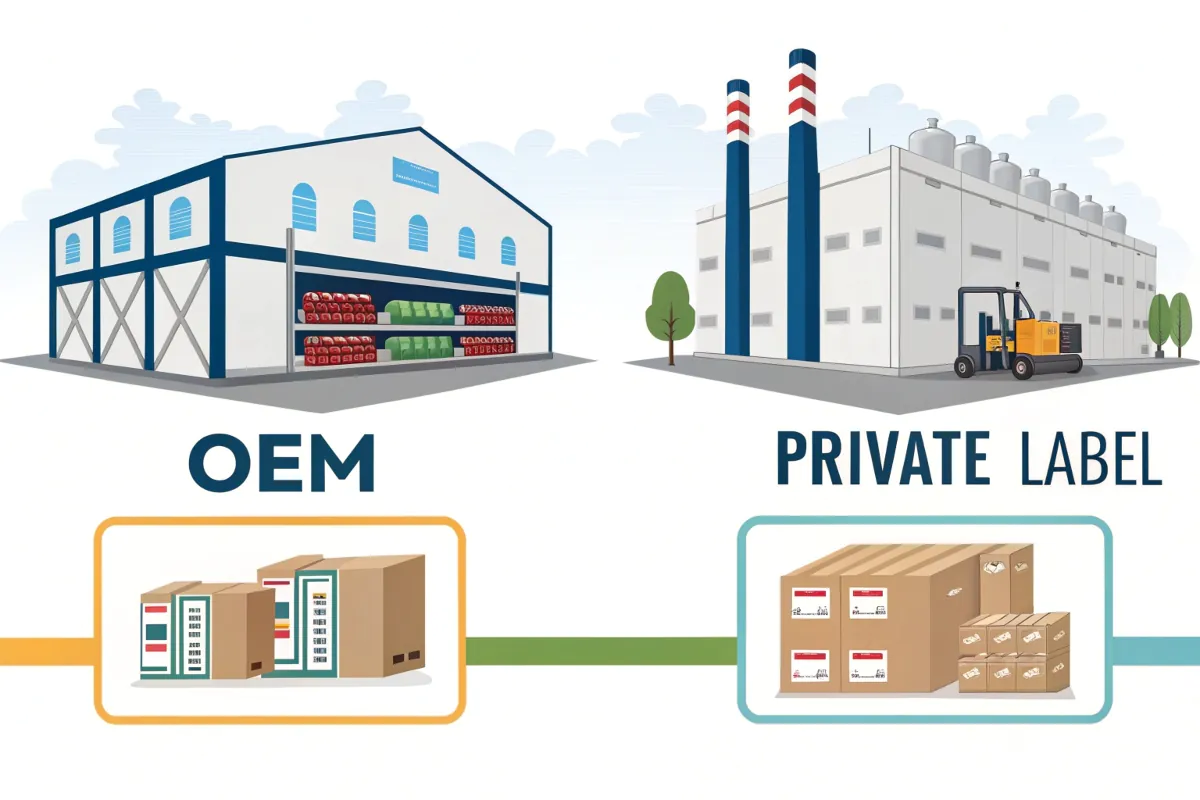
Choosing the right manufacturing model is one of the most critical decisions you’ll make as an importer. The model you select determines your cost, timeline, profit margins, competitive advantage, and whether your business succeeds or struggles. Yet many first-time importers choose based on intuition rather than understanding the real trade-offs. Here’s the unfiltered truth about each model.
The Three Models Defined
OEM (Original Equipment Manufacturer)
What it means: You design the product (or commission a designer), and the factory manufactures it according to your exact specifications. The factory is essentially an extension of your engineering team—they build what you tell them to build, nothing more.
Who controls what:
- You design the product
- You specify materials, components, colors, dimensions, and features
- You own the intellectual property (IP)
- You handle all certifications and compliance
- The factory simply executes your vision
Real example: Apple designs the iPhone in California. Foxconn (an OEM) manufactures it in China according to Apple’s detailed specifications. Apple owns the design; Foxconn is just the manufacturer.
ODM (Original Design Manufacturer)
What it means: The factory creates products based on its own designs and technology, but allows you to customize certain elements like branding, colors, packaging, and minor features. You’re essentially buying a proven, existing design and making it yours.
Who controls what:
- Factory owns the core product design and technology
- You customize branding, colors, exterior design, and packaging
- Factory may allow minor feature modifications
- Factory typically handles certifications
- You leverage pre-existing designs and tooling
Real example: A Chinese factory designs and manufactures a standard wireless speaker. You can buy it with your brand logo, custom colors, and custom packaging, but the internal technology and core design are theirs.
Private Label
What it means: You apply your brand to standard, off-the-shelf products with minimal customization. The factory’s design, tooling, and technology remain unchanged—you’re just changing the packaging and branding.
Who controls what:
- Factory completely owns the product design and all specifications
- You control only the brand name, logo, and packaging
- Minimal feature customization possible
- Factory handles all certifications
- You resell a standardized product under your brand
Real example: A factory manufactures a standard portable power bank. You buy thousands with your brand name on the packaging, but the internal design is identical to what they sell to dozens of other brands.
Side-by-Side Comparison
| Factor | OEM | ODM | Private Label |
|---|---|---|---|
| Product Design | You design it | Factory designs; you customize | Factory design only |
| Development Cost | $75,000–$150,000 | $5,000–$15,000 | $15,000–$50,000 |
| Development Timeline | 8–12 months | 60–90 days | 3–6 months |
| Tooling/Mold Cost | $30,000–$80,000 | $0–$5,000 | $10,000–$30,000 |
| Minimum Order Quantity (MOQ) | 1,000–3,000 units | 500–1,000 units | 500–2,000 units |
| Unit Price | High initially; lowest at scale | Mid-range | Lowest upfront |
| Design Differentiation | Completely unique | Moderate customization | Minimal differentiation |
| IP Ownership | You own it | Factory owns it | Factory owns it |
| Time to Market | 10–14 months | 2–3 months | 3–5 months |
| Quality Control | Your standards | Factory standards | Factory standards |
| Certification Responsibility | Entirely yours | Shared/Factory-covered | Mostly factory-covered |
| Flexibility/Changes | Medium | High | Very high |
| Brand Differentiation | Maximum | Moderate | Minimal |
| Risk Level | Highest | Lowest | Low-Medium |
The Real Costs: What Manufacturers Won’t Tell You
OEM: The Hidden Expenses
When manufacturers quote you “$75,000–$150,000” for OEM development, they’re often omitting critical costs:
Tooling & Molds: $30,000–$80,000
- Metal molds for injection-molded parts
- Dies for metal stamping
- Fixtures and jigs for assembly
- Often not included in the initial quote
Certification & Testing: $10,000–$50,000+
- Safety testing (UL, CE, FCC, etc.)
- Lab testing for functionality
- Retesting if initial tests fail (common)
- Documentation and submission fees
Engineering Revisions: $5,000–$30,000
- Your design rarely works perfectly on first try
- Revisions are common—budget for 2–4 rounds
- Each revision requires new samples and testing
Design Services (if you don’t have in-house engineers): $20,000–$60,000
- Hiring external design/engineering firms
- CAD drawings and technical specifications
- Prototyping and refinement
Total realistic OEM cost: $140,000–$270,000+
A European home appliance brand I consulted with initially quoted $85,000 for OEM development of a steamer. Final costs reached $220,000 after accounting for three certification failures, design revisions, and mold adjustments.
ODM: Low Upfront, Hidden Flexibility Costs
ODM appears cheap ($5,000–$15,000), but flexibility comes at a price:
Customization fees: $2,000–$10,000
- Changes to colors, materials, or exterior design
- Non-refundable fees for custom molds or tooling
- Rush charges if timelines are tight
Minimum order commitments: $10,000–$50,000
- Many ODMs require minimum spend, not just unit quantities
- This can mean 2,000–5,000 units for lower-cost items
- Larger commitments than initial discussions suggest
Less negotiating power: Your margins suffer
- Since you’re using their existing design, you have limited negotiation leverage
- Price reductions come only at very high volumes (10,000+ units)
Private Label: Lowest Upfront, Inflexible Long-Term
Private Label has the lowest upfront cost but creates challenges as you grow:
Packaging customization: $5,000–$30,000
- Custom boxes, inserts, labels
- MOQs for custom packaging (often 10,000+ units)
- Design and artwork fees
Branding materials: $3,000–$10,000
- Hang tags, instruction manuals, warranty cards
- Multi-language requirements
The real cost: Limited differentiation
Once you’re committed to a factory’s design, changing suppliers is difficult. You’re essentially locked in because switching to a different design means rebuilding your entire supply chain.
The Timeline Reality
OEM: The Long Road
Realistic timeline breakdown:
- Months 1–3: Design finalization and engineering
- Months 3–4: Prototype development and revisions
- Months 4–7: Certification and testing
- Months 7–9: Mold/tooling creation and validation
- Months 9–12: Initial production runs and quality validation
- Months 12–14: First shipment arrives at your warehouse
Total: 10–14 months before your first revenue-generating sale
This is why many OEM projects fail—entrepreneurs underestimate the 12+ month investment before seeing any return.
ODM: The Fast Track
Realistic timeline breakdown:
- Weeks 1–2: Select from factory’s design catalog
- Weeks 2–4: Request and review samples
- Weeks 4–6: Approve samples and finalize customizations
- Weeks 6–8: Produce and ship first order
Total: 2–3 months from decision to warehouse delivery
The speed is real, but it comes with the trade-off of limited differentiation—you’re one of many brands using the same base product.
Private Label: Fastest Entry
Realistic timeline breakdown:
- Weeks 1–2: Select standard product (no customization needed)
- Weeks 2–4: Arrange packaging and branding
- Weeks 4–5: Produce first order
- Weeks 5–7: Warehouse arrival
Total: 4–7 weeks from concept to revenue
This speed is unmatched, but you’re immediately competing on price, not product uniqueness.
When OEM Makes Sense (and When It Doesn’t)
OEM is appropriate when:
✓ You have a genuinely unique product idea backed by market research proving consumer demand
- Vague ideas like “a better phone charger” are not enough
- You need validated proof that customers want your specific innovation
✓ You have sufficient capital ($150,000–$300,000+ minimum)
- This covers development, tooling, certification, and working capital for initial inventory
- Startups with $50,000 will run out of cash before launch
✓ You have engineering expertise in-house or access to trusted engineers
- Without this, your design will have flaws, causing rework costs
- Hiring external design firms adds $20,000–$60,000
✓ You can tolerate 12–18 month development timelines
- OEM is not for businesses needing to launch quickly
- Market windows close; trends change; this timeline is punishing for time-sensitive products
✓ Your market rewards differentiation with premium pricing
- If customers won’t pay 20–30% more for your unique design, OEM ROI is negative
- B2B and premium consumer segments are better fits than mass-market retail
OEM becomes a liability when:
✗ You lack engineering expertise
- Without it, you’ll face design failures, certification setbacks, and cost overruns
- A brand without an engineering team attempting OEM is setting themselves up for failure
✗ Your capital is limited (<$150,000)
- OEM will deplete your budget before you see any revenue
- You’ll have no cash left for marketing, inventory, or operational costs
✗ Your market is price-sensitive
- If customers shop primarily on price, the premium you get from unique design won’t offset higher OEM costs
- Mass-market retail (Walmart, Amazon) typically rewards price, not differentiation
✗ You’re entering a saturated market
- If dozens of competitors already offer similar products at lower prices, a custom design alone won’t save you
- Differentiation requires more than just a unique product design
Real example: A startup founder wanted to create a “revolutionary cordless steamer” through OEM. After spending $95,000 on development, they discovered consumers wouldn’t pay the $89.99 price point required to cover costs. With ODM, they could have tested market acceptance by launching at $39.99 first, validating demand before investing heavily in custom development.
When ODM Makes Sense
ODM is appropriate when:
✓ You want fast time-to-market without excessive capital investment
- ODM is ideal for capitalizing on seasonal trends or emerging niches
- 2–3 month timeline enables you to respond quickly to market opportunities
✓ You have moderate capital ($25,000–$75,000)
- Enough to cover development, initial inventory, and operational costs
- You’ll have capital left for marketing and customer acquisition
✓ You’re entering an established market with proven demand
- Using an existing product design means less technical risk
- You know the product works before you invest in customization
✓ You want moderate customization without full control
- ODM allows you to differentiate through colors, materials, packaging
- You maintain brand control without engineering complexity
✓ Your product category has proven designs (electronics, apparel, home goods)
- Most common consumer product categories have mature ODM options
- Factories have years of refinement in the base product
ODM is less ideal when:
✗ You need maximum differentiation
- If competitors use the same factory and base design, you’re all nearly identical
- Your only differentiator becomes price, packaging, or marketing
✗ Your product requires unique technology
- ODM factories won’t invest in proprietary tech unless you commit to very large volumes
- If your competitive advantage is technical, OEM or custom engineering is necessary
✗ You need long-term IP protection
- Factory retains all design IP; they can sell to competitors
- No contractual exclusivity exists (unless negotiated at very high costs)
When Private Label Works
Private Label is appropriate when:
✓ You want the fastest, lowest-risk entry to market
- 4–7 weeks from concept to revenue-generating sales
- Minimal capital needed; maximum speed
✓ Your capital is severely limited (<$25,000)
- Private Label requires the lowest upfront investment
- You can launch while bootstrapping with revenue
✓ You’re testing market demand before committing
- Use Private Label to validate that a market exists
- Once sales prove demand, upgrade to ODM or OEM
✓ Your competitive advantage is marketing/branding, not product
- If you can outmarket competitors through social media, content, or community, the product design matters less
- Many successful brands started with Private Label and grew through marketing excellence
✓ You’re entering a mature, price-competitive category
- Where product innovation matters less than brand perception and pricing
- Examples: basic phone chargers, standard power banks, commodity items
Private Label limitations:
✗ Zero competitive differentiation from product standpoint
- You’re one of dozens (or hundreds) selling identical products
- Price becomes your only weapon
✗ Minimal IP control
- You own nothing but the brand name
- The factory can sell to your direct competitors
✗ Supplier lock-in risk
- Switching suppliers means completely rebadging and repackaging
- You’re dependent on a single factory
✗ Commodity pricing pressure
- As the product becomes commoditized, prices drop
- Difficult to maintain margins long-term
The Business Stage Decision Matrix
Your ideal model evolves as your business grows. What works for a startup is rarely optimal for an established brand.
Stage 1: Startup/Entry Phase (Your Situation?)
Recommended Model: ODM (or Private Label if capital-constrained)
Why:
- Minimize capital requirement
- Prove product-market fit before heavy investment
- Launch quickly to test market
Metrics:
- Capital available: $20,000–$50,000
- Monthly target sales: 500–1,000 units
- Time-to-market importance: Highest
- Competitive differentiation: Secondary
Example execution:
- Select 3–5 established ODM products in your category
- Order samples from top manufacturers
- Test-sell top 2 designs on Amazon/Shopify
- Scale highest performer to 1,000+ units/month
- Transition to Private Label or ODM-Plus (deeper customization) once validated
Stage 2: Growth/Expansion Phase (6–18 months in)
Recommended Model: Private Label with ODM customization
Why:
- You’ve proven demand exists
- Higher volume justifies customization investment
- Build brand identity while maintaining efficiency
Metrics:
- Capital available: $75,000–$200,000
- Monthly sales: 2,000–5,000 units
- Time-to-market importance: Medium
- Competitive differentiation: Growing importance
Example execution:
- Launch 2–3 new SKUs using different factories
- Heavy investment in packaging and branding differentiation
- Negotiate exclusive colors or feature bundles with ODM factories
- Build brand moats through superior packaging, unboxing experience, customer service
- Reduce reliance on single factory by qualifying multiple suppliers
Stage 3: Mature/Market Leader Phase (18+ months in)
Recommended Model: OEM for premium/flagship products; ODM for volume products
Why:
- You have capital and operational infrastructure
- Proprietary technology becomes valuable at scale
- Premium differentiation justifies OEM investment
Metrics:
- Capital available: $250,000–$1,000,000+
- Monthly sales: 10,000+ units
- Time-to-market importance: Lower (you set the pace)
- Competitive differentiation: Critical
Example execution:
- Develop signature OEM product (flagship offering)
- Use ODM for complementary, volume SKUs
- Invest in R&D for next-generation innovations
- Build brand around proprietary technology
- Expand into adjacent categories
Real success story: One online retailer started with Private Label power banks (3 SKUs), grew to $500K/month revenue through superior branding and customer experience, then invested in ODM customization for unique capacity/feature combinations. At $2M/month, they developed a proprietary fast-charging technology (OEM) that became their differentiator. At each stage, their manufacturing model matched their business maturity.
The Hidden Factory Perspective
To choose wisely, understand how factories see these three models—and what that means for your negotiations.
Factory Profitability & Priority
| Aspect | OEM | ODM | Private Label |
|---|---|---|---|
| Factory Profit Margin | Medium (custom complexity) | High (standardized) | Highest (minimal work) |
| Priority When Busy | Lowest (lowest volume potential) | Medium | Highest (easiest) |
| Engineering Resource Cost | High | Low | None |
| Production Line Efficiency | Medium (custom setup) | High | Highest |
| Repeat Order Likelihood | Low (once design is perfected, you may source elsewhere) | High | Highest |
What this means for you:
- OEM clients receive lowest priority during factory capacity constraints. If demand spikes and your ODM or Private Label customers need production, your OEM project gets delayed.
- Component sourcing favors ODM/Private Label clients. When supply chains are disrupted, factories allocate scarce components to standardized products first, then to custom projects.
- Certification changes hurt OEM most. When safety regulations update (as they do regularly), your custom design may require recertification and redesign. The factory won’t bear this cost; you will.
Factory perspective: A factory would much rather have 100,000 units of their standard Private Label design across 30 customers than 5,000 units of your custom OEM design. The Private Label customer is far more profitable and predictable.
Comparative Risk Assessment
Understanding risk helps you choose the model that aligns with your risk tolerance:
| Risk Category | OEM | ODM | Private Label |
|---|---|---|---|
| Technical Failure Risk | High—Your design may not work as intended | Low—Design already proven | Low—Design already proven |
| Market Rejection Risk | High—Unproven product concept | Low—Existing market demand | Low—Existing market demand |
| Quality Issues Risk | Medium—You set specs; factory may cut corners | Low—Factory has established QC | Low—Factory has established QC |
| Supply Chain Risk | High—Custom components have fewer alternatives | Low—Standard parts from multiple suppliers | Low—Standard parts from multiple suppliers |
| IP/Patent Risk | Low—You own the design | High—Factory owns design; can sell to competitors | High—Factory owns design; can sell to competitors |
| Capital Loss Risk | Highest—Can lose $150K+ if design fails | Medium—Can lose $25K+ if market assumptions wrong | Low—Can lose $10K+ if wrong product choice |
| Competitive Differentiation Risk | Low—Your design is unique | Medium—Others may use same design | High—Many identical products in market |
| Timeline Risk | Highest—12+ month development; markets change | Low—2–3 months; market validated | Low—4–7 weeks; existing product |
Decision Framework: Which Model Should You Choose?
Answer these five questions honestly:
1. How much capital can you invest without jeopardizing your business?
- <$25,000 → Private Label
- $25,000–$75,000 → ODM
- $75,000–$150,000 → ODM with customization
- $150,000 → OEM is possible, but only if other criteria align
2. How much time until you need revenue?
- <2 months → Private Label
- 2–4 months → ODM
- 4–6 months → Private Label or ODM with heavy customization
- 6+ months → Any model; OEM if capital allows
3. Is your competitive advantage based on product design or brand/marketing?
- Product design (unique features, tech, materials) → OEM
- Both equally → ODM
- Mostly branding (packaging, marketing, customer experience) → Private Label or ODM
4. Do you have proven demand for your specific product concept?
- Yes, validated through pre-sales or research → ODM or OEM
- Moderate confidence → Private Label (test first)
- Uncertain → Private Label (validate with minimal risk)
5. What’s your risk tolerance?
- Very low (can’t afford to fail) → Private Label
- Low-to-Medium → ODM
- Medium-to-High → OEM
The Bottom Line
The “best” manufacturing model doesn’t exist—only the right model for your specific situation. Most successful importers don’t start with OEM. They start with Private Label or ODM, prove the concept works, build capital, and then invest in custom development when they have the resources and market validation to justify it.
Three habits of successful importers:
- Choose the model that matches your current capital and timeline, not your aspirations
- Plan for transitions—expect to upgrade your model every 12–18 months as you grow
- Validate market demand before heavy investment—use fast, cheap models first to test; invest heavily only once demand is proven
The importers who fail are often those who insist on OEM from day one, then run out of capital before launch. The ones who succeed are those who pragmatically match their manufacturing model to their reality—starting fast and cheap, proving the concept works, and then investing in differentiation once the business has momentum and capital.